Posts

When do you really need to start seeing a nephrologist (a kidney doctor)?

Image
I often call kidney disease the "Rodney Dangerfield of Medicine". It gets no respect! Well, outside of the medical community, the same could be said for nephrologists (to a certain extent)! No one is quite sure what they do, or why does anybody need to see one anyway.  For some, we are just another version of urologists. Nephrologists, as the readers of this blog know are physicians who specialize in the diagnosis and treatment of kidney disease, electrolytes, high blood pressure, dialysis, kidney stones, etc. 

How does kidney disease affect your sexual health and reproductive function? What are your treatment options?

Image
Kidney disease has a profound effect on sexual health, fertility, the ability to conceive, etc. I will cover the issues related to chronic kidney disease (CKD) and pregnancy in my next post . For today, lets try and understand how and why a reduction in your kidney function could affect your sexual health. Sexual dysfunction does tend to worsen as kidney disease progresses, and is part of the constellation of various signs and symptoms of advanced kidney disease .

What is "Chronic Kidney Disease", or CKD?

Image
In my previous  post , I had talked about how physicians check your kidney function, as well as the concept of glomerular filtration rate (a measure of your kidneys' function, or more accurately, its filtration capacity), or GFR. I want to talk today about an entity that you might have heard before: chronic kidney disease, or CKD.  CKD is a generic, umbrella term. Nephrologists define it as " kidney damage or reduction in kidney function that persists for 3 or more months ". The definition does not include the cause of kidney disease. In other words, whether you have reduction in kidney function from diabetes, or high blood pressure, or a genetic cause, you could still carry a common diagnosis of CKD. This diagnosis is then further subdivided in to stages 1 thru 5, depending on the disease severity. This is where the concept of GFR that I talked about  before  becomes useful.    Take a look at the above picture (courtesy of The National Kidne...

How do physicians check your kidneys' function?

Most people know that getting a stress test is a way to test your heart's function. But how do you test your kidney function? You might have heard doctors mention words like "creatinine", or "GFR" when checking how good or bad your kidneys are doing. Although there are a lot of methods by which the kidneys' performance can be measured, I will explain the ones that are used most often in clinical setting

Diet for patients with kidney disease: A little sweet, a little salty, and what to eat more/less of?

Image
You are what you eat. Your kidneys are no different. Diet and lifestyle have a huge influence on the development of kidney disease, as well its rate of progression once it develops. Hence, in my practice, and especially in patients with early stage chronic kidney disease (CKD)  or  stage 3/early stage 4 ,  I place a strong focus on diet (in addition to treating the cause of CKD) which may sometimes go a long way in preventing disease progression. This does not mean that the right diet is not important in advanced stages of CKD. It very well is; however, you will probably need more aggressive medical management in those stages. I have emphasized before that, like many other things in life, prevention is not only better than cure, it is much much easier too. Once GFR (glomerular filtration rate, a measure of your kidney function) permanently declines, it is unlikely that it will increase. Hence GFR decline is often a " one way highway ".

Environmental Toxins That Cause Kidney Disease and Failure

Image
Toxins present in the environment are a common but under-appreciated cause of kidney disease and kidney failure. Environmental causes typically include chemical agents (eg. heavy metals), physical agents (eg. high temperature/heat, dehydration), and biological/infectious agents (eg. malaria, HIV etc). Here is an overview of some exposures and their sources that you should be aware of:

Can we create an artificial/mechanical kidney to treat kidney failure?

Image
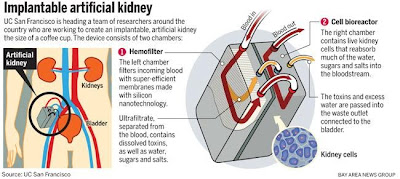
THE FUTURE IS HERE.....WELL, ALMOST! It has been a while since researchers started working on developing prototypes of artificial kidneys that could literally be implanted in to a human suffering from kidney failure. Theoretically, this kind of artificial kidney would replace the functions of a normal human kidney. It would flush the blood of all metabolic toxins, maintain all body electrolytes in the narrow range necessary for all life processes, produce hormones like erythropoietin (that drives the bone marrow to produce red blood cells), activate vitamin D, regulate blood pressure, etc etc. Yes, these are all some of the functions that those miracles of nature sitting in your flanks, your kidneys, are doing right now.